

What a sheet costs by length
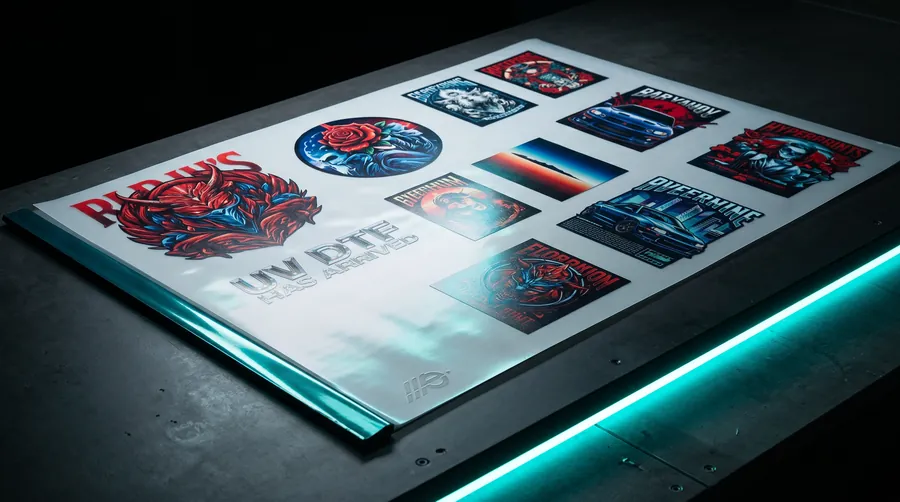
DTF runs about $0.60 per inch of sheet length and UV DTF about $1.25 per inch. Here is what that comes to at the standard lengths.
| Sheet length | DTF (estimate) | UV DTF (estimate) |
|---|---|---|
| 24 in | $14.40 | $30.00 |
| 36 in | $21.60 | $45.00 |
| 48 in | $28.80 | $60.00 |
| 60 in | $36.00 | $75.00 |
| 72 in | $43.20 | $90.00 |
| 96 in | $57.60 | $120.00 |
| 120 in | $72.00 | $150.00 |
Fill the width first
Since you pay for length, empty space beside a design is wasted film. Before the sheet gets any longer, look across it. Check the sheet width shown in the builder and work out how many copies of each design fit side by side.
Small size changes can add a whole column. If one more logo fits across when it drops from 4 inches wide to 3.75, take it. On a left chest nobody will see the difference, and over a long run that extra column shortens the sheet.
Rotate and nest
- Rotate designs 90 degrees when that packs the row tighter. A tall, narrow sleeve print often belongs on its side. Orientation on the sheet does not matter, because you cut each piece out before pressing.
- Nest small pieces into the gaps. Round and irregular designs leave open corners. Neck labels, sleeve hits and hat-size logos fit there.
- Group by height. Rows of similar-height designs stack cleanly. One tall design in a row of short ones leaves a dead band across the sheet.
- Fill leftover space with things you always need: your shop neck label, sample prints, spare copies of the job.
Spacing
Leave enough room between designs to cut them apart without clipping the art. Many shops keep roughly a quarter to half an inch, more if they cut by hand with scissors and less if they trim on a cutter. Go tighter than you can cut and one bad pass ruins two transfers. Keep art off the very edge of the sheet as well.
Size by placement
Art sized without a placement in mind usually ends up too big, and oversized transfers eat length. Common starting points in the trade are about 3.5 to 4 inches wide for a left chest and 10 to 12 inches wide for an adult full front, with youth sizes smaller. Neck labels and sleeve prints run a few inches.
Measure the garment or the tumbler, size the art to it, then place it on the sheet. Most shops also work at 300 dpi at print size, so nothing has to be scaled up after it is placed.
Plan one sheet for several jobs
A gang sheet does not have to be one order. If Thursday holds a 24-piece left chest job, 12 full backs for a crew and a handful of reprints, lay them out together. The full backs set the rows, and the left chests and neck labels fill the space beside them.
- List every design with its size and quantity before you open the builder.
- Add spares. A couple of extra copies cost little when they fill space you already paid for, and they save a reorder when a press goes wrong.
- Place the largest designs first, then fit the small ones around them.
- Keep DTF and UV DTF on separate sheets. Each has its own builder.
- When the layout is done, match the length to it. If the art ends between two standard lengths, set a custom length instead of paying for blank film.
Check the cost per transfer
Divide the sheet price by the number of transfers on it. A 36 inch DTF sheet at an estimated $21.60 that holds 40 logos comes to 54 cents each. Fit 48 on the same sheet and it is 45 cents. That is the number to carry into your quote, and it is the quickest way to compare two layouts of the same job.
Questions
How is a gang sheet priced?
By sheet length. DTF is about $0.60 per inch and UV DTF about $1.25 per inch. These are estimates, and the builder quotes the exact price as you build.
What sheet lengths can I order?
Standard lengths are 24, 36, 48, 60, 72, 96 and 120 inches. Custom lengths from 12 to 240 inches can be set in the builder.
Can I upload a sheet I laid out myself?
Yes. Build the sheet in the online gang sheet builder or upload a finished sheet.
How much space should I leave between designs?
Enough to cut them apart cleanly. Many shops use about a quarter to half an inch, which is general trade practice and not a Hyperprints requirement.